

Hey friends, Chase here
There is a particular kind of silence that can change the direction of a life. Not the peaceful kind. Not the silence you seek out when you need space to think. I mean the silence that lands in the room right after you say something true. The silence after you tell people what you really want. The silence after you say, out loud, that you are thinking about leaving the safe path and choosing the one that actually feels like yours.
I remember that silence very clearly. I remember the day I told my family I was going to leave the path everyone expected for me and become a photographer. This was not me announcing a hobby. It was not a side project. It was not some casual thing I thought might be fun to explore. I was saying, in effect, this is what I feel compelled to do. This is the direction I have to chase.
And the room got quiet.
My parents were not against it, and I want to be clear about that. But I could feel the worry. I could feel the polite smiles and the nods that were probably covering up a very natural concern. I was worried too. I knew it was scary. I knew I might embarrass myself. I knew I might blow up my financial security, fail publicly, and end up crawling back to a “real job.” That fear was real.
But that moment stuck with me because it mattered. It still matters. Because so much of what keeps us from the life we want is not the actual failure. It is the fear of being seen before we know how the story ends. It is that quiet pause after we name the dream.
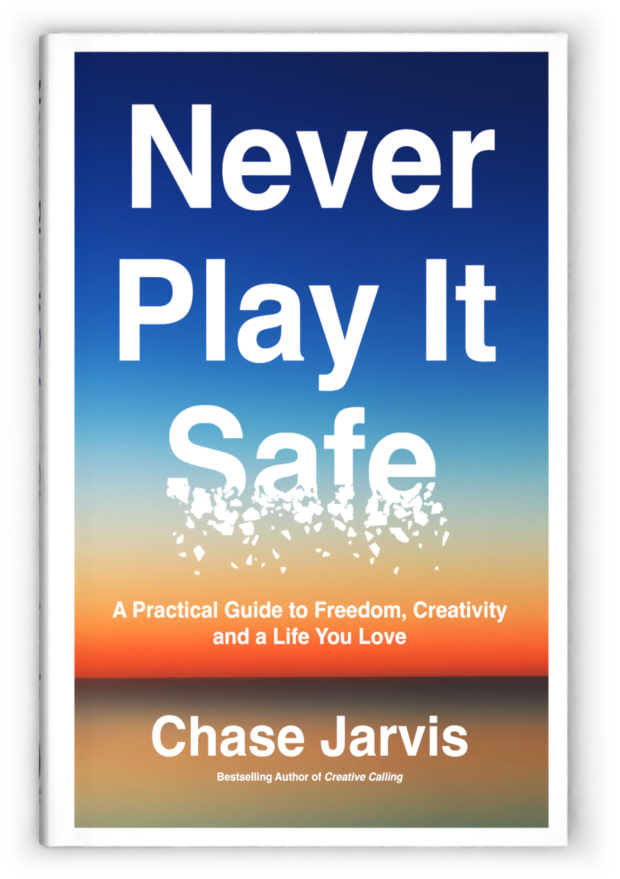
That is what this episode is about. Betting on yourself, not because there is no fear, but because fear cannot be the thing that gets to design your life.
🎧 Listen to the Episode Right Here:
The Moment After You Say the Thing
There are obvious forms of resistance in life. Someone tells you no. A door closes. A plan falls apart. A check does not clear. Those things are hard, but at least they are clear. What I am talking about here is more subtle. It is the tiny moment after you reveal what you want and the people around you do not immediately understand.
That moment can feel like a verdict, even when it is not. Somebody pauses, and suddenly you start filling in the blanks. Maybe they think I am crazy. Maybe they are disappointed. Maybe this dream is irresponsible. Maybe I should have kept it to myself. And before anything has actually happened, the fear begins doing its work.
I have come to believe that this is one of the places where a lot of people stop. Not because someone actively shut them down, but because the silence felt too uncomfortable. If everyone cheered immediately, maybe they would keep going. If everyone criticized them loudly, maybe they would have something to push against. But the silence is different. It creates space for doubt, and doubt can be incredibly persuasive when the dream is still fragile.
So if you are somewhere in your life right now wondering whether it is too late, whether you missed the window, whether you are allowed to want something different, I want you to pay attention to that. Especially if you cannot honestly say that you are 100% going after your dreams. This one is for you.
Playing It Safe Is Usually Fear in Disguise
Most of us do not say, “I am afraid, so I am not going to do the thing.” We use better language than that. We say we are being practical. We say we are being responsible. We say we are waiting for the right time, the right plan, the right amount of money, the right amount of certainty. And sometimes those are legitimate considerations. I am not here to tell you to be reckless.
But I am here to say that playing it safe is often fear wearing a very respectable outfit.
Fear has a job. It is optimized for survival. That is useful when you are in actual danger. But fear is not optimized for creativity. It is not optimized for happiness, joy, connection, harmony, fulfillment, or the gifts you have to give and receive in this life. Fear wants to keep you alive. It does not care if you feel fully expressed.
That matters because if you let fear make all your decisions, you may end up safe, but you will also end up smaller than you were meant to be. You will build a life around avoiding discomfort rather than moving toward aliveness. And the best stuff in life is usually just on the other side of the comfort zone you are coddling.
By the way, craving comfort is natural. Of course it is. We all want security. We all want belonging. We all want the people we love to understand our choices. But comfort cannot be the only thing we optimize for. At some point, the question becomes: am I protecting my life, or am I hiding from it?
The World Will Keep Throwing Curveballs
If you are going for it, the world is going to throw you curveballs. That is part of the deal. Not because the world is against you, but because challenge is how you grow. The world cannot really give you anything. It can only challenge you until you become stronger.
And when you get stronger, the hard things do not magically become easy. They become easier. That distinction matters. I am not promising a frictionless life. I am not saying the fear disappears or that the path suddenly becomes smooth. I am saying that you become more capable. You become more practiced. You learn how to meet the pitch that used to scare you.
What I do not want is for you to quit. I do not want you to take your bat and go home. I do not want the first or fifth or fiftieth curveball to become the reason you stop playing the game you actually came here to play. Whether you meet those challenges as punishment or as part of a playful game of discovery is up to you. But either way, the challenges are coming.
The invitation is to stay in the game long enough to find out who you become when you stop retreating every time it gets uncomfortable.
Your Weaknesses Might Be Invitations
There is something I wish more people said plainly: your weaknesses can be blessings. Not because weakness feels good. Not because fear is fun. Not because we need to romanticize struggle or pretend that everything difficult is automatically noble. But because the places where you feel weak are often the places where you are being invited to grow.
That fear you feel right now does not necessarily mean you are doing the wrong thing. It may mean you are standing at the edge of something important. Courage is not the absence of fear. Courage is having fear and doing it anyway.
This is easy to forget after years of teaching ourselves to avoid friction. Years of performing the version of ourselves that other people understand. Years of telling ourselves stories about what is realistic, acceptable, responsible, or too late. Over time, you can lose track of what you actually want. You can get so good at managing other people’s expectations that you forget to ask whether the life you are maintaining is the life you want to be living.
But the desire does not disappear just because you ignore it. It waits. It keeps tapping. It shows up in restlessness, envy, curiosity, frustration, and that persistent feeling that there is something more honest available to you.
The Opposite of Playing It Safe Is Freedom
The opposite of playing it safe is not reckless risk. That is not the message. This is not about blowing up your life just to prove you are brave. It is not about risk without measure. The opposite of playing it safe is freedom.
Freedom is creating the ultimate game of life and then deciding that you are actually going to play. It is betting on yourself with your eyes open. It is taking calculated risks in the direction of what is true for you. It is refusing to let fear be the only voice in the room.
That is why I keep showing up. Every week I write an email, create posts, record this show, and share work online because, in a very real way, I am betting on you. I am betting that you will see this work for what it is: a belief that you can activate. You can take calculated risks. You can get to work on your truest dreams.
And more than anything, I want you to join me in that bet.
What You’ll Hear in This Episode
This is a short episode, but the message is direct. If you have been waiting for permission, certainty, or universal understanding before you move toward the life you want, this is your reminder that fear does not get the final vote.
- Why the silence after you share your dream can feel so powerful, and why it keeps many people from taking action
- The story of telling my family I was leaving the expected path to pursue photography as a career
- Why playing it safe is often about fear, even when we call it responsibility
- Why fear is optimized for survival, not creativity, joy, connection, or fulfillment
- Why the comfort zone is natural to crave, but dangerous to build your whole life around
- How the world challenges you until you become stronger
- Why your weaknesses can become opportunities to grow and be brave
- Why courage means having fear and acting anyway
- Why the opposite of playing it safe is not recklessness, but freedom
- Why betting on yourself is a practice, not a one-time declaration
Timecodes So You Can Jump to What You Need
If you’re not listening straight through, here are a few landmarks to help you find the part that speaks to where you are right now:
- 00:00 – A note about my weekly email and where I put my attention every week
- 01:50 – Welcome to the micro show and the short message behind today’s episode
- 02:07 – The memory of telling my family I was leaving the expected path to become a photographer
- 02:44 – The quiet room, the polite smiles, and the worry underneath the silence
- 03:08 – The fear of public failure, financial insecurity, and having to crawl back to a “real job”
- 03:32 – Why the fear of saying what you want can keep you from taking action
- 04:11 – Why the silence after you announce your dream can be more powerful than encouragement or criticism
- 04:37 – The question: are you 100% going after your dreams?
- 05:04 – Playing it safe, fear, and why fear is optimized for survival
- 05:33 – The best stuff in life is on the other side of the comfort zone you are craving
- 05:54 – The world will throw curveballs as long as you are still playing
- 06:16 – Why challenges become easier as you get stronger
- 06:43 – Your weaknesses as blessings and invitations to grow
- 07:11 – Courage is having fear and doing it anyway
- 07:33 – The opposite of playing it safe is freedom
- 07:56 – Why I’m betting that you can activate, take calculated risks, and get to work on your truest dreams
- 08:19 – The invitation to join me in the bet
- 08:42 – A quick thank you for listening, sharing, and growing together
Read This If You Feel Like It Might Be Too Late
If you feel like it might be too late to go after your dreams, start by telling the truth. Are you 100% going after what is true for you? Not what looks good from the outside. Not what keeps everyone comfortable. Not what you chose five or ten or twenty years ago because it made sense at the time. What is true now?
For most people, that question is uncomfortable because it removes the hiding places. It asks us to admit where we have settled. It asks us to look at the gap between the life we say we want and the choices we are actually making. That can sting. But it can also wake us up.
“Too late” is often fear disguised as wisdom. It sounds mature. It sounds practical. It sounds final. But sometimes it is simply the story we tell ourselves so we do not have to risk being seen trying. Trying is vulnerable. Trying means you might fail. Trying means people might watch you change direction. Trying means you might have to admit that the safe path is not the satisfying one.
But not trying has a cost too. The cost is your aliveness. Your creativity. Your sense of possibility. Your relationship with the part of you that still knows there is more.
Stop Treating Fear Like a Stop Sign
Fear is information. It is not an instruction. It can tell you that something matters. It can tell you that you are stepping outside familiar territory. It can tell you that identity, security, belonging, and ambition are all tangled together in this next move. That is useful information. But it is not the same as a command to stop.
Sometimes fear means prepare. Sometimes fear means slow down and get clear. Sometimes fear means make the risk more calculated. Sometimes fear means ask for help. But fear does not automatically mean abandon the dream.
If you wait until fear disappears before you act, you may wait forever. The practice is learning to move with fear. To take the next honest step while your hands are still shaking. To understand that courage is not a feeling you wait for, but a behavior you choose.
A Simple Practice for Betting on Yourself
Here is a simple way to make this real. Start by naming the thing you have been afraid to say out loud. Write it down plainly. No polishing. No over-explaining. Just the truth. Then ask yourself whose silence you are afraid of. Who are you imagining in the room? Whose pause, judgment, worry, or disappointment has more power over your choices than it should?
Once you have that, separate fear from fact. Write down what is actually true, and then write down what fear is predicting. Those are not always the same thing. Fear loves to present a prediction as a certainty. Your job is to notice the difference.
Then choose one calculated risk. Not a reckless leap. Not the whole mountain. One honest action that moves you toward what you want. Send the email. Make the call. publish the work. Have the conversation. Block the time. Start the project. Admit the dream to someone you trust.
The goal is not to eliminate fear. The goal is to build evidence that you can move with it.
Don’t Take Your Bat and Go Home
As long as you are still playing, you are going to get curveballs. That does not mean you are doing it wrong. It means you are in the game. The temptation, when things get hard, is to turn challenge into evidence that you should quit. To decide the safe path was safer for a reason. To take your bat and go home.
But growth comes from staying in the game long enough to get stronger. The things that feel impossible today may not become easy tomorrow, but they can become easier. You can become more capable. You can become more resilient. You can learn how to meet the pitch.
That is why betting on yourself matters. It is not blind optimism. It is a commitment to keep participating in your own life.
Questions to Ask Yourself
- What dream have I been afraid to say out loud?
- Whose silence am I afraid of?
- Where am I mistaking discomfort for danger?
- What am I calling “practical” that might actually be fear?
- What comfort zone am I currently protecting?
- What curveball has the world thrown at me, and what is it asking me to learn?
- Where could one of my weaknesses become an invitation to grow?
- What would courage look like today, even if the fear does not go away?
- What calculated risk would move me closer to my truest dreams?
- What would it mean to bet on myself this week?
The Core Idea
Bet on yourself. Not because success is guaranteed. Not because fear will disappear. Not because everyone will understand immediately. Bet on yourself because the alternative is letting fear quietly design your life.
The silence after you say what you want is not proof that you are wrong. The discomfort is not proof that you should stop. The fear is not the enemy. Fear is optimized for survival, but you are not here merely to survive. You are here to create, connect, grow, and give what is yours to give.
The opposite of playing it safe is not reckless risk. The opposite is freedom. It is creating the ultimate game of life and then deciding that you are actually going to play.
So today, I’m betting on you. I’m betting that you can activate. I’m betting that you can take calculated risks. I’m betting that you can get to work on your truest dreams. And more than anything else, I want you to join me in that bet.
Until next time: stop treating fear like a stop sign, stay in the game, and bet on yourself.