


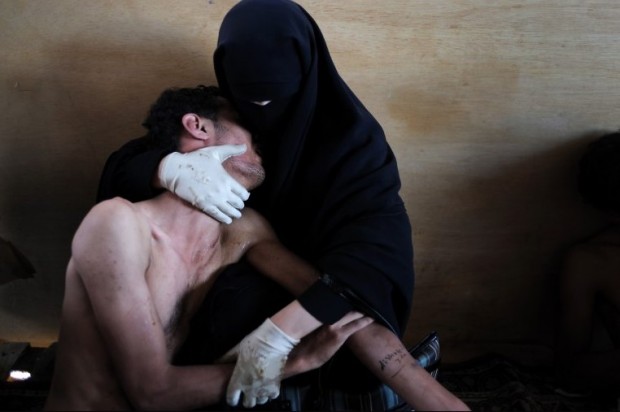
A woman holds her wounded son in her arms, inside a mosque used as a field hospital by demonstrators against the rule of President Ali Abdullah Saleh, during clashes in Sanaa, Yemen on 15 October 2011
Here’s a few some of my favorites from the bunch on the tabs above. Even though some of these images are heartbreaking, there is inspiration in them, call to action, awareness. They’re depicting real people, real lives–and also the really hard work of the people who chase down the stories.To be a great photojournalist, you have to be immersed. You can’t hide behind the lens…you have to actually GO. Meet people. Shake hands. Ask questions. Which is sometimes unthinkable in war zones and impoverished nations. These folks did it.
All of these photos and captions are via World Press Photo.






The photographer who took the second image, Remi Ochlik, was killed in Syria on Wednesday. You can see more here….
http://lens.blogs.nytimes.com/2012/02/22/parting-glance-remi-ochlik/
These are heartbreaking images and wonderfully taken but I agree with the comments about, “…they only pick ones where it’s overseas politically war driven”. We know what’s going on in the world. The hunger, the violence because that is what we are bombarded with everyday in the news. I am not trying to disregard the plights of others who are less fortunate than us (Americans). I would like to see someone win with a very touching, wonderful picture of an accomplishment or victory, no matter what country it came from. Let’s see something positive that has made an impact on the world.
I think the line between powerful photography and a powerful moment has blurred a little too much for me. There is a reason people hire professional photographers for their weddings. To them, it is one of the most important and powerful days of their lives. That being said, crappy, out of focus, poorly composed shots will not do. If that makes sense…
That said, when you are in the middle of getting shot at in Afghanistan and you are still responsible for documenting those events, the content becomes a lot more important than the rule of thirds. Kinda like that photo of the girl with the fish in her mouth. There is water all over that lens, she is dead centered, and overall it’s not a “great looking PHOTOGRAPH” But that’s not what photojournalism is entirely about. It’s about documenting events. These are all good depictions of what’s happening in the now. Comparing a wedding and photojournalism isn’t realistic. You shoot a few shots at a time, because who knows when you’ll get to charge your camera again on some assignments, or when you’ll be able to download. Suddenly it’s like the days of film again. You can delete, sure, but I know I wanted to make sure there was space should some crap go down and I needed to KNOW I would have card space. I think [and there’s the magic phrase that everyone loves to use 😉 ] that in a world where everyone can grab a DSLR and call themselves a photographer, and photoshop is where you can “fix it later” for any ol’ person, the bar has been set…. not too high, but, has been mistakenly set for photojournalists. Everyone thinks they know about what makes a great photo and there has become such an emphasis on composition, quality, lighting, etc, that people are forgetting journalism is about content first and foremost.
Wow, what a rant, eh. Anyways, good opinions all over, and I think the photos aren’t all that bad 😉
These are hard-hitting images, Chase. With the recent news of two more journalists being killed in Syria it makes you respect the role journalists play in our society more than ever before. Thank you for sharing.
So sorry to see the captions take precedence over the imagery. So much social activism involved in the “selection” of “best” as defined by those with political agendas in the media… Sad.
Dave WIlliams: I 100% agree. If you take away the captions on a few photos, your left with just a couple random portraits, and they only pick ones where it’s overseas politically war driven.
It’s a photojournalism prize, of course a journalistic element is considered when they award the prize. As Kyle says, if you take away the captions you’re just left with random portraits and photojournalism isn’t about random portraits!
I don’t think this is bad photojournalism at all. Maybe not all photos are just as great, but I really like mot of the shots even without the captions.
Take for example the photo of the woman put out of her appartment. For me, the photo told the story itself already. And yes ofcourse, the caption adds a lot to the photo, but I don’t think the photos are worthless without the captions.
That’s just what I think,
Daniel
I agree with Dave’s comments. Most of these photos are not actually news but a focus on human misery and degradation. There’s so much more to life than the emphasis of the media (newspapers and nightly news) on their daily drum beat of death, murder, bad news, criminality, etc. In my opinion many of these photos are meant to make us feel bad and go into agreement with how bad life is. If we are made to agree enough with the fodder of the merchants of chaos, we soon see that’s the way life is. Nothing could be more untrue.
I didn’t feel the emotion or inspiration from most of the pictures. Most of them gives that fake image feels like from movies like 300. Overaly post processed to try to inject emotions rather than capturing? I did like the drum pic though.