


UPDATE: if you dig mirrorless cameras or want to find out why everybody else loves them, you’re in luck. creativeLIVE has courses on mirrorless cameras by the talented John Greengo. Go here to check it out, learn more, enroll, etc.
______
I like to shoot with the newest, biggest, baddest DSLR as much as the next guy. And I’m lucky enough to do so on the regs for my commercial work; however, when it comes to my day-to-day shooting (when I’m not snapping with my…ahem…iPhone) I’m having fun with Olympus OM-D’s and E-P3’s. I’m blown away with the images these little beauties put out. There are a whole gaggle of new cameras in this category that beg a look. So I called on my camera review pal who has used most of what is out there, Sohail Mamdani, to do a breakdown of the latest cameras in this category. Read on for what might be best for you in this category -Chase
Unless you have been living under a rock, you are aware of a new class of cameras. This class goes by many names – the Large Sensor Compact (LSC), the Mirrorless Interchangeable Lens Compact (MILC), and Electronic Viewfinder Interchangeable Lens (EVIL) are a few of the labels that have been used to describe this generation of cameras, but most of them seem to fall short in one way or another. The collective refers to this category as “Mirrorless”, as that is the one thing they all have in common.
Today we’ll take a look at five cameras that are leading the charge in this category.
Olympus OM-D EM–5
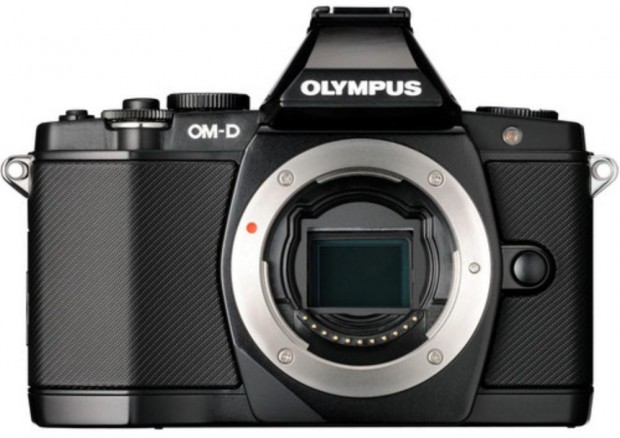
The OM-D EM–5 from Olympus.
Back in the film days, Olympus made a 35mm SLR camera called the OM–2. It was a neat little camera, and was pretty successful in its time. Looking at the OM-D, with its new Micro-Four-Thirds body from Olympus, it’s pretty clear that this little baby is of the same design pedigree as the OM–2. In fact, if you look at it from the front with a lens on, it’s not hard to imagine the OM-D as a film camera itself.
Flip it over, though, and the 3-inch OLED touch-capable screen dispels that notion completely. The OM-D may carry forward the retro look that Olympus pioneered for its digital cameras with the E-P1, when it brought back the venerable PEN moniker, but the insides are cutting-edge tech all the way.

DNG from Olympus OM-D, with Lightroom edits. © Sohail Mamdani
Reviewers of the OM-D have been almost gushing about this little body – and with good reason. It seems to have breathed new life into a brand that’s been hit by scandal over the last several months. The image quality of the OM-D is superb, and I’ve taken to using this camera as my carry-round body with 12-35mm f/2.8 and 35-100mm f/2.8 lenses from Panasonic. (Chase shoots this body with the 12mm fixed 2.0…) With the OM-D’s in-body image stablization, I’ve gotten steady shots at down to 1/6th of a second, and the details captured by this compact body are downright impressive.
From its fast autofocus (Olympus claims it has the world’s fastest AF system at the moment) to its impeccable low-light performance, the OM-D hits enough hot spots that some pros are switching to this diminutive body as their primary camera.
The Good: Fast Autofocus, excellent low-light performance, fantastic in-body 5-axis image stabilization.
The Bad: Not much. Continuous Autofocus tracking is a bit on the unreliable side sometimes.
Who it’s Ideal For: Outdoor enthusiasts and photojournalists. You can use Panasonic’s 12-35mm and 35-100mm lenses and have an effective 24-200mm range covered. And in a package that is much smaller and weighs much less than, say, a Canon 5D Mark III body with 24-70mm f/2.8 and 70-200mm f/2.8 lenses.
Buy it: $999 (Body only) from B&H Photo
Rent It: From BorrowLenses.com, starting at $44
Fuji XE–1/X-Pro1
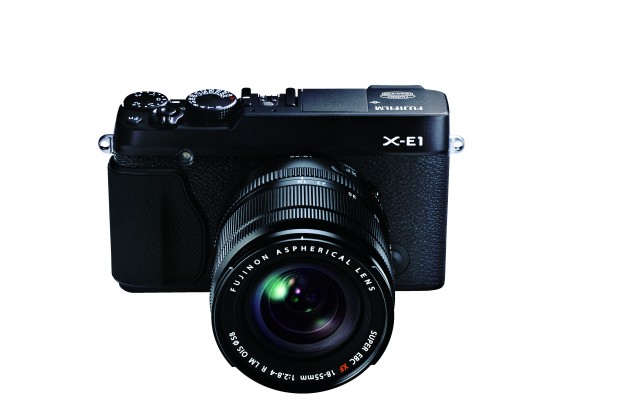
The Fuji XE–1
Okay, this is really two cameras, but they’re such close cousins that you can go with either one.
Fuji began its foray into the mirrorless market with the highly-acclaimed (yet quirky) X100. This was a remarkable camera in many ways – it featured a large APS-C sensor, a fixed 23mm (35mm equivalent) f/2 lens, a leaf shutter system, and a fantastic retro design that was every bit as eye catching as the images it produced. Fuji eventually followed up that single-lens model with the X-Pro1, which, while suffering from many of the same quirks as its predecessor such as slow autofocus performance, was a sellout on launch.
The XE–1 is similarly back-ordered, and with good reason. It keeps the sensor of the X-Pro1, which has managed to wow many folks with its color and detail reproduction, but packages things into a smaller size. It ditches the hybrid optical/electronic viewfinder found in the X-Pro1 in favor of an all-electronic viewfinder. Like the X-Pro1, the industrial design drips with retro finesse, and it maintains full compatibility with all of Fuji’s X-Mount lenses. There’s also a Leica lens adapter, so your manual focus Leica lenses will work with the XE–1 as well.
Fuji X-series of cameras definitely have some kind of special sauce in them. Fuji packs in a number of effects that emulate their classic film stocks like Velvia and Provia. Photographers who have worked with the X cameras, like Zack Arias, have been repeatedly blown away. Here’s what Zack had to say after taking a particularly striking image with his X-Pro1.
And I was sold. I’m in. I got it. It’s worth every effing rupee, peso, penny. I don’t care. I’m not in Bombay any more. I went somewhere else and once this light was gone I woke up with the X-Pro1 in my hands and yes. Ummm… maybe? No. Ummm… Yes. I zoomed in on this image to check focus. “Hot Damn.” It was one of the greatest personal moments of my professional life.
Honestly, if you can handle the X-series’ quirks, there is something pretty satisfying about the images coming from these cameras.
The Good: Fantastic image quality, cool retro design.
The Bad: Weird sensor design means RAW compatibility with Lightroom/Aperture is slow to arrive and doesn’t work as well.
Who it’s Ideal For: Portrait and landscape artists will love the high image quality, rich colors and the Fuji film profiles like Velvia and Provia baked into the JPEGs. Street photographers will like the retro rangefinder look and feel, which seem to put people more at east than a large DSLR and bazooka-sized lens.
Buy it: $1399 (X-Pro1 body only) or $999 (X-E1 body only) from B&H Photo
Rent it: The X-Pro1 From BorrowLenses.com, starting at $59
Sony NEX–6
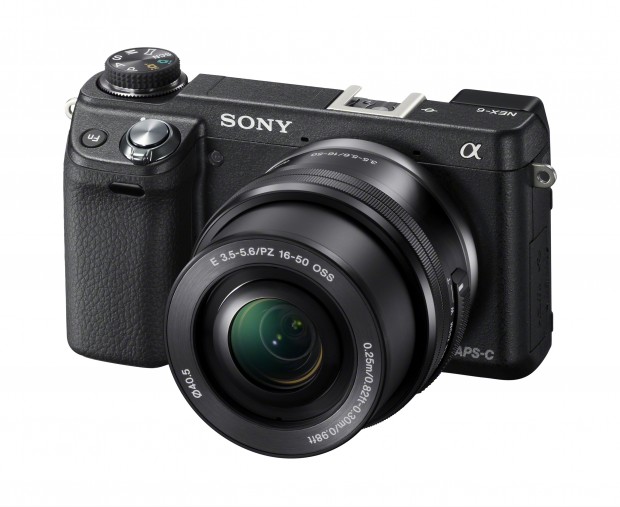
The Sony NEX–6
Sony’s NEX series has been getting a lot of great press, and with darn good reason, too. The company has been making good on its promise to commit to the photography market, and its NEX compact cameras have been extremely well-received.
What’s remarkable about these Sony cameras is that Sony isn’t afraid to throw stuff at the wall and see what sticks. That leads, interestingly enough, to features being included in mid-range models like the NEX–6 that aren’t in the higher-end NEX–7. WiFi is now included in the NEX–6, so you can do things like view the images on the card in the camera on your smartphone.
You also have improved autofocus performance due to the inclusion of a hybrid system that uses both phase-detection and contrast-detection sensors. Most of the time, mirrorless cameras use only contrast-detection sensors, which are slower than the phase-detection sensors used in DSLRs. Low-light performance is also improved over the NEX–7, and to my surprise, is pretty awesome for a camera this size. I expect to see angry red, green and blue dots at ISO 3200, but instead, the noise that is there is more reminiscent of the big, fat grain you’d see in ISO 3200 film.

High-ISO (3200) image with the NEX-6. © Sohail Mamdani
There is an entire ecosystem of adapters that allows for the use of Canon, Nikon, Sony Alpha-mount and other lenses on the NEX cameras(I’ve written more about that here). The stable of E-mount lenses is still growing, but is doing so rapidly.
What’s Good: Great image quality, low-light performance, small size.
What’s Bad: Needs more native E-Mount lenses.
Who it’s Ideal For: Pros looking for a small, compact shooter with performance to spare. Also, anyone shooting Sony’s DSLRs who wants to leverage their existing lenses via adapters on a smaller body.
Buy it: $848 (body only) from B&H Photo
Rent It: From BorrowLenses.com, starting at $50
Panasonic GX1
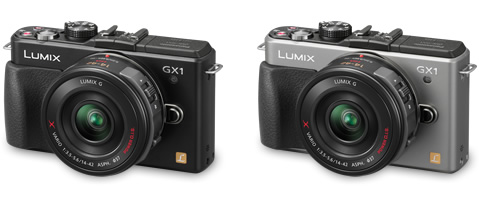
The Panasonic GX-1
Panasonic is the other primary partner in the Micro-Four-Thirds standard (with Olympus), and its cameras have received excellent reviews as well, including DPReview.com’s Silver Award. The GX1, released last year, marked a departure from the single-model lineup of Panasonic’s Micro-Four-Thirds camera into two separate lines, the GF series and the GX series. The GF series was marketed more for beginners stepping up form a point-and-shoot, whereas the GX series was intended more for advanced amateurs or pros looking for a more pocketable camera.
There’s a lot to like about the GX–1. It’s smaller and lighter than many of its competitors, and has a touch-screen for added controls. One thing I found was that due to fact that you can do things in more than one way (physical control or touch-screen), you often find yourself hesitating and wondering if you should use the physical knobs and buttons or the touchscreen to accomplish a task. This kind of sorts itself out as you keep using the camera, and the touchscreen is useful for some tasks.
Where Panasonic really shines is in their lenses. The standards for most photographers are the 24–70mm, 70–200mm, 50mm, and perhaps a Macro in the 90–105mm range. Panasonic delivers soundly with a 12–35mm, 35–100mm and a Leica co-branded 45mm Macro, as well a 25mm f/1.4 lens. Because of the smaller sensor, you experience a crop factor of 2x, so the 12–35mm f/2.8 becomes a 24–70mm f/2.8, and so forth.
What’s even cooler is that the 12–35mm and 35–100mm zooms have optical image stabilization, which neither Canon nor Nikon have included in their 24–70 f/2.8 zooms yet. Moreover, Panasonic also offers a 7–14mm (14–28mm equivalent) f/4 zoom, which is particularly useful for landscape users.
And of course, since Panasonic is part of the Micro-Four-Thirds consortium, it can use MFT lenses from Olympus, Sigma, and other manufacturers.
What’s Good: Excellent lens selection, small, relatively cheap.
What’s Bad: Controls are cramped and a bit clumsy, not the most innovative industrial design.
Who it’s Ideal For: Beginners looking to step up to a camera with room to grow. Also, given the plethora of adapters for MFT cameras to adapt everything from recent Nikkor lenses to ancient M42-mount optics, it’s a nice step up to give that old glass a new lease on life.
Buy It: $449 (body only) from B&H Photo
Leica M9
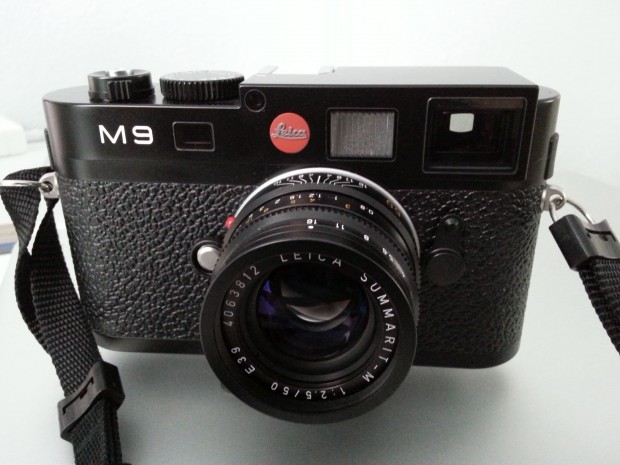
Leica M9
If you’re surprised to see the Leica here, don’t be. People tend to forget that before the trend towards mirrorless cameras started, Leica was already there with their digital rangefinders. The legendary camera of legendary photographers, the overall design of the Leica M series hasn’t changed much since the film days, keeping an emphasis on classic elegance that has become the German company’s trademark and has inspired at least three of the models I mention here.

Leica DNG, treated in Silver Efex Pro 2. © Sohail Mamdani
In the digital world, Leica has really scored with the M9. It’s a big step up from the M8 (and the new “M”, with no number after it, is apparently even better), and adds some interesting features like a first-rate bracketing option (though it feels weird to try and shoot HDR with a Leica) and better high-ISO performance. Here’s what I had to say about shooting with a Leica for a few weeks a while back.
Using a Leica distils the experience of shooting down its very core elements, and when you’re used to the photographic equivalent of driving a loaded Lexus LS with all the amenities, being dropped into the equivalent of a 1970′s-era Porsche 911 is a shock.
A pleasant shock in many ways, but a shock, nonetheless.
Leica’s lenses are another reason for its reputation. I keep using the word “legendary” here, and with good reason; these optics have some kind of magic that, in the right hands, deliver an image that is almost three-dimensional in nature.
Is it expensive? Yep. But if you can get your hands on one (rent one, if you can), it’s worth experiencing this little bit of history.
Leica recently refreshed their “M” series line, introducing the “M” (no numbers now) and the “M-E”. The new “M” camera sports a CMOS sensor in place of the old CCD and adds a number of features that bring the Leica series further in line with modern-day cameras. These features include 1080p video, Live-View, an optional EVF, and improved ISO performance.
Those looking to keep the spirit of the old bare-bones Leica alive will love the M-E. The M-E strips the camera down to its essentials – no video here, or Live-View, or EVF. You also have the old CCD sensor instead of the new CMOS, which is not a bad thing at all.
What’s Good: Built like a tank, fantastic image quality, remarkable glass.
What’s Bad: It’s a Leica. I’m not allowed to say anything bad about it (but if I were, I’d say the high-ISO performance isn’t good and the buffer is tiny).
Who it’s Ideal For: Besides Henri Cartier-Bresson? Well, surprisingly, a number of types of shooters. From street photographers (natch) to landscape and portrait artists, to travel photographers and photojournalists, the Leica can work for just about anyone looking for high-end optics, tank-like construction, and a camera with a deep and formidable history.
Buy it: $6400 (body only for the M9), $5450 (body only for the M-E), $7000 (body only for the new M)
Rent it: M9 from BorrowLenses.com, starting at $225
Conclusion
Mirrorless cameras are coming on strong, and they are rapidly gaining ground as people stop thinking that a great camera with a large sensor has to look like a DSLR. The image quality from cameras like the Leica, the Fuji and the Olympus are allowing the classic manufacturers to come back with a vengeance, while the newer kids on the block, like Sony and Panasonic, are putting out some incredible technology into the field of photography.
Will mirrorless cameras become the predominant cameras out there? I don’t know. There may be certain types of photography that these diminutive devices will always be unsuited for (sports photography comes to mind). But for many of us, mirrorless cameras may well become de rigeur for all kinds of everyday shooting. Just as the iPhone and other phone cameras are slowly replacing point-and-shoots for many uses, so too might the NEX–6 replace the D7000 for many uses. The cameras listed above are just the start; the product pipeline in this class promises to be even more exciting in the coming years.
Gear provided by BorrowLenses.com – where still photographers and videographers can rent virtually everything.













for every project you need certain tools…I still have a NikonD300 with 120,000 actuations and going strong…and I will still use itwhen the occasion calls for it …but I now have 2 mirrorless cameras…I use the Nikon 1 V1 for shooting street and it is a great tool for that as it can easily be put into stealth mode and can be set to a silent shutter…and I am using the Olympus Pen E-PM2 to shoot indoor amateur ice hockey…I have been shooting hockeyfor quite a few years now but this little Olympus with a 45 1.8 lens on it is giving me the sharpest images ever for hockey…the other night I was shooting ISO 3200 and shutter speed of 1/800th and getting really clean images…the autofocus is fast and the touch screen really helps the focus get it right…2 amazing little machines…when you need a screwdriver use a screwdriver and when you need a hammer use a hammer
I’ve been using an EPL-1 for a couple of years now and have an extreme love-hate relationship with it. I love to use it for walking around in good to decent light, it is so convenient, the IS is great and the colors are like the Fourth or July. Pure velveeta. I hate the lag and the low-light performance is just not very good and the autofocus is quirky, so when the kids are running around the yard I end up with more pictures of the backs of their heads running away than their smiling faces runnign towards, and it is useless for sports. But for a walk in the park, it is the cat’s pajamas. The images are just so much fun….until you reach the limits of the camera. It can’t yet replace my DSLR but it breathed a little life into my hobby. Looking forward to an eventual ugrade; that EM-5 and Fuji look gorgeous.
Get a E-PM2 or another body with the same sensor in it. You’ll not regret it and I think you can ditch that DSLR too.
I bought the OM-D (silver) in November primarily as a walk-around/secondary camera, still planning to lean on my Nikon D700 as my go-to kit. But I am quickly falling in love with size and agility of the OM-D. I don’t see myself abandoning the DSLR world quite yet, but I’m curious to see which will get more use over the next few months.
Hi
I had the X-E1 for a week testing from Fuji with the new software updates (@ED) the focussing issues are solved! It was a really nice camera to work with, especially for street and portrait work.
But for the more bigger productions I still Prefer a DSLR like my 5D MKII. Because of the bigger feel and expectations of a client for a photographer with big camera.
So for coming year I will update to the 5d MKIII And want to add the X-E1 as a holiday fun back up camera. But don’t forget you can get great images with the X-E1. I loved the 35mm (50mm eqv) on it!
I have an Olympus E-PL5 but I was curious if the Fuji X-E1 could outperform it. So I borrowed one and compared the two. It’s amazing, but the Olympus photos were at least as good as the ones from the Fuji X-E1. Yes, the images have slightly more noise, but also more detail. With some mild noise reduction the images looked very, very close to those of the Fuji. The Olympus images needed no sharpening but the Fuji images did. I didn’t like the build quality of the Fuji either, so no Fuji for me. That camera feels a bit cheap.
I’ve been very happy with the Samsung NX210. It’s one camera that doesn’t get mentioned enough in the “compact” discussions….
yes it is a nice camera…you know the wonders it can perform…enjoy…I have a Nikon 1 V1…and it has received a lot of bad press…but I love it…I use it for street and convert to black and white…people bad mouth products without even trying them…people know Nikon and Canon but Samsung is not well known as a camera maker….it is a good camera and outshines the Canon model in the mirrorless world