

Hey friends, Chase here
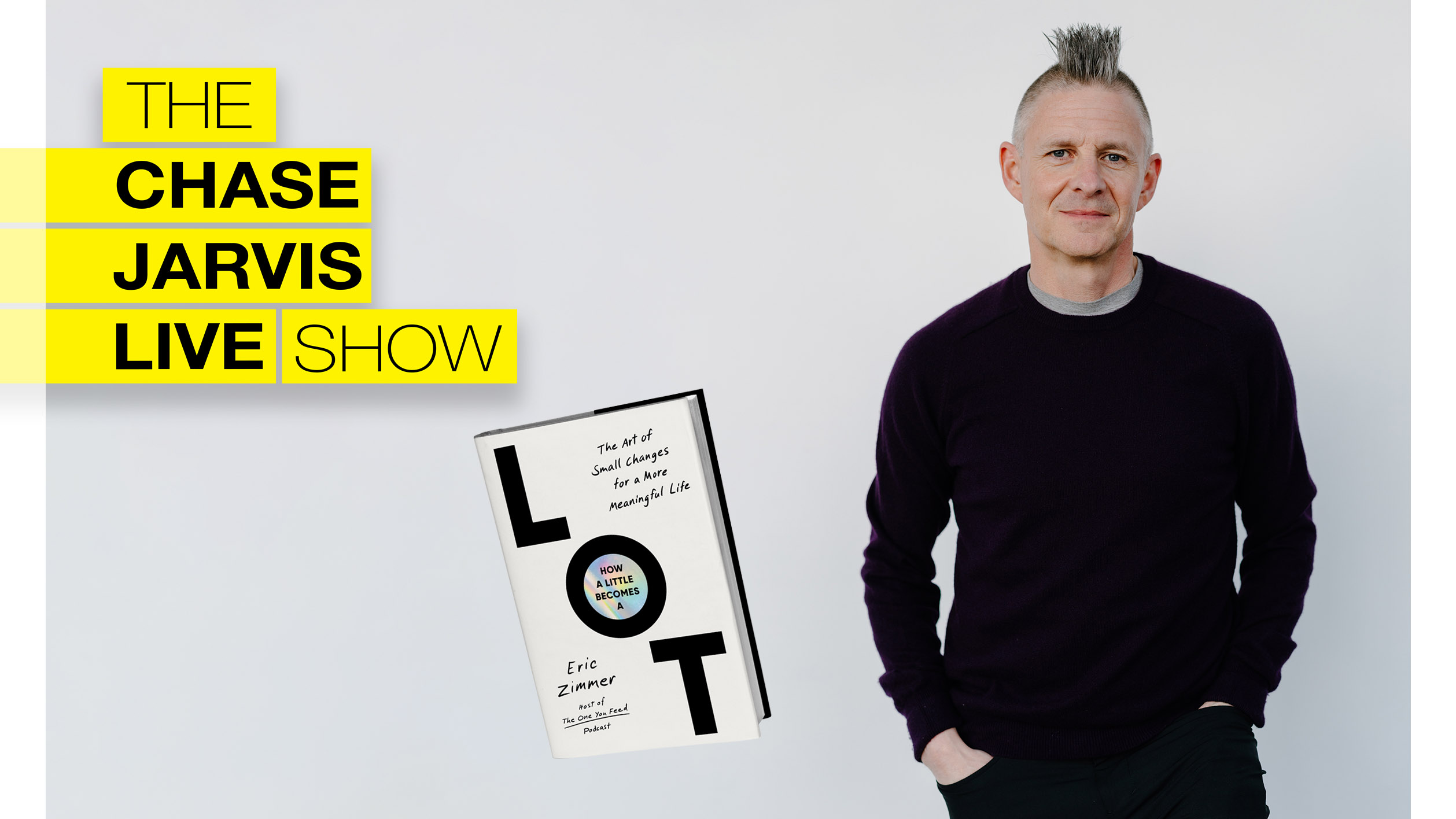
Eric Zimmer is on the show today, and this conversation is exactly the kind of reminder we all need when we are trying to change something real.
You probably know Eric from The One You Feed, his award-winning podcast about wisdom, behavior change, mental health, spirituality, and what it means to live well.
But Eric’s new book, How a Little Becomes a Lot: The Art of Small Changes for a More Meaningful Life, goes somewhere even more fundamental.
It asks a question that feels especially urgent for creators, entrepreneurs, leaders, parents, and anyone trying to build a meaningful life in a world that constantly tells us to optimize everything:
What if lasting change is not about becoming more disciplined, but about learning how to stop fighting yourself?
That question matters because most of us have made change too heavy. We wrap it in shame, pressure, perfectionism, identity, ambition, self-criticism, and the fantasy of the big breakthrough. We get stuck waiting for the epiphany, the watershed moment, the dramatic turn where everything finally becomes clear.
Eric’s message is simpler, deeper, and more freeing:
“There are moments that stand out because we pull them out and we pluck them out and we make them important, but they don’t make sense without the moments before and after. There’s all these little, deeply uninteresting moments where I made a small choice to move towards my recovery and away from my addiction again and again. And that’s the way change really works.”
That idea is the center of this episode. We talk about Eric’s journey from homelessness and heroin addiction to recovery, coaching, teaching, and writing; why your mind has a mind of its own; how to work with competing desires instead of pretending they are not there; and why small choices compound into a completely different life.
This conversation is about loosening the grip. It is about getting back to the part of you that knows what matters, even when another part of you wants comfort, distraction, escape, or relief right now.
🎧 Listen to the Episode Right Here:
Why This Conversation Matters Right Now
We are living in a strange moment for anyone who wants to grow. On one hand, there has never been more access to tools, ideas, books, podcasts, teachers, frameworks, research, and practices that can help us change.
That is extraordinary.
But it also comes with a cost. The pressure to optimize every corner of our lives has never been stronger. Every scroll seems to bring another routine, another system, another habit, another rule, another version of the person we are supposed to become.
We are constantly being asked to improve ourselves:
- What is your morning routine?
- What habit are you tracking?
- What are you optimizing?
- What are you building?
- What are you eliminating?
- What is the plan?
Those questions can be useful at the right time. But when they show up too early, or too often, they can turn growth into another way of beating ourselves up.
Eric’s work reminds us that change begins with honesty. Before the perfect habit. Before the flawless system. Before the heroic reinvention. Before the new identity. Before the transformation story, there is a person being pulled in different directions.
Wanting to change. Wanting to stay comfortable. Wanting what matters most. Wanting what feels good right now. Wanting freedom. Wanting safety. Wanting growth. Wanting acceptance.
That does not mean something is wrong with you.
It means you are human.
And in that understanding, there is a kind of wisdom most self-improvement advice forgets.
What We Explore in This Episode
- Eric’s low point at 24 and how homelessness, heroin addiction, illness, and the threat of prison became the beginning of his recovery journey.
- Why the big turning point is not the whole story and why change actually happens in the small choices that come after.
- How to understand the “off-camera moments” of transformation that never make the montage but make all the difference.
- Why your mind has a mind of its own and what it means to be a motivationally complex person.
- How to work with what you want now and what you want most without shaming yourself for having competing desires.
- Why “playing the tape all the way through” can help you see past the first scene your mind wants to show you.
- How structure and story both shape change, and why systems alone are not always enough.
- How to hold change and acceptance at the same time when life refuses to fit into simple categories.
- Why trying smaller can create momentum when trying harder is not working.
The Core Idea: Little by Little, a Little Becomes a Lot
The fastest way to get unstuck is often to stop waiting for the big transformation and start paying attention to the next small choice.
We get obsessed with the dramatic moment. The rock bottom. The epiphany. The vow. The clean break. The day everything changed. We want the music to swell. We want the story to make sense.
Eric’s story has one of those moments. At 24, he was homeless, addicted to heroin, physically depleted, and facing the possibility of decades in prison. Going into long-term treatment mattered.
But Eric is careful not to confuse the turning point with the transformation.
The transformation was not one decision.
It was thousands.
The decision to move toward recovery again. The decision to not use again. The decision to show up again. The decision to do the next small thing again. The decision to choose what mattered most over what felt urgent right now.
The on-camera moment gets the attention. The off-camera moments create the life.
Eric’s point is not that ambition does not matter. It is not that insight does not matter. It is not that we should abandon goals, systems, or discipline.
It is that the living center of change is choice.
The small one comes first.
Your Mind Has a Mind of Its Own
One of the big tensions in this conversation is the voice many of us carry around that says, “If I really wanted to change, this would be easier.”
That voice says:
- You should have more discipline.
- You should be more consistent.
- You should know better by now.
- You should not still struggle with this.
- You should be able to just decide.
Eric’s response is that we are not simple creatures. We are motivationally complex.
We do not want one thing. We want lots of things.
We want what we value most, and we want what feels good right now. We want to grow, and we want to be comfortable. We want to change, and we want to be accepted exactly as we are.
That is why the phrase “your mind has a mind of its own” is so useful.
It gives language to something we all experience.
You decide you are going to do one thing, and then you watch yourself do another. You know what would help, and still you avoid it. You care deeply about the future, and still the present moment feels more real.
The work is not to shame that complexity out of yourself.
The work is to understand it.
Play the Tape All the Way Through
One of my favorite parts of this conversation is Eric’s explanation of a recovery practice called “playing the tape all the way through.”
When we want something in the moment, our mind often shows us only the first scene.
The first scene is relief.
The first scene is escape.
The first scene is pleasure, comfort, avoidance, or release.
In Eric’s addiction, that first scene was all the reasons getting high would feel amazing. But recovery taught him not to stop there. He had to keep the tape running.
Then what?
The shame comes back. The fear comes back. The despair comes back. The consequences come back. The craving comes back, often stronger than before.
This is such a powerful tool because it makes the future less abstract.
Before you avoid the work, play the tape through.
Before you send the angry email, play the tape through.
Before you break the promise to yourself, play the tape through.
Not to punish yourself.
To see clearly.
Structure Matters, But It Is Not the Whole Story
Eric makes an important distinction in this episode between the external architecture of change and the internal moments of choice.
A lot of personal growth advice focuses on structure.
Set the goal. Build the system. Make the habit obvious. Make the habit easy. Design the environment. Remove friction. Put the right reminders in place.
That matters.
But structure is not the whole story.
Because even when you know exactly what to do, and even when you have made it as easy as possible, the moment still comes.
You and the choice.
Do you write?
Do you walk?
Do you call?
Do you tell the truth?
Do you choose what you want most over what you want now?
When we do not make the choice we wanted to make, Eric says there is usually something happening inside us. A feeling. A thought pattern. A story. A fear. A form of self-doubt we have not learned how to work with yet.
That is why real change needs both.
The structure and the story.
Try It Smaller
Eric says something in this episode that every ambitious person should sit with:
Try it smaller.
That does not mean the goal does not matter. It means the path has to be walkable.
When a change plan is not working, many of us assume we need more discipline. More pressure. More intensity. More accountability.
But often, the better move is to make the action smaller.
If you cannot write for two hours, write for ten minutes.
If you cannot meditate for 30 minutes, sit for three breaths.
If you cannot change your whole health routine, put on your shoes and walk around the block.
If you cannot face the entire project, open the document.
Small does not mean meaningless.
Small means repeatable.
And repeatable is where momentum comes from.
Change and Acceptance Are Not Opposites
Another major theme in this episode is the tension between growth and acceptance.
One of the best parts of us wants to change. We want to grow, improve, heal, create, recover, repair, and build better lives.
And yet, so many wisdom traditions point us toward acceptance. Presence. Contentment. Allowing things to be as they are.
So which is it?
Do we change, or do we accept?
Eric’s answer is that very often we have to do both about the exact same thing.
He talks about depression in his own life. Is that something he has changed, or something he has accepted?
Both.
There are things he does that make depression less likely. There are practices, supports, behaviors, and choices that help. And sometimes the cycle comes around anyway, and the most skillful thing he can do is say, “Oh, this is what’s here.”
That is not resignation.
That is honesty.
Wise Habits Create Momentum With Compassion
The title of Eric’s book is not just a catchy phrase. It is a worldview.
A little becomes a lot.
Not because one tiny action changes everything overnight, but because small choices compound. They build identity. They build trust. They build momentum. They begin to align our daily actions with our deeper values.
Eric calls these Wise Habits.
They are not just outer behaviors designed to make us more efficient. They also include inner attitudes that bring more peace, clarity, and self-compassion to everyday life.
That matters because self-criticism is often mistaken for seriousness.
We think if we are hard enough on ourselves, we will finally change.
But harshness usually creates more resistance. More shame. More hiding. More all-or-nothing thinking.
A Wise Habit does something different.
It helps us move forward without declaring war on ourselves.
Ask What Problem You Are Solving
Near the end of the conversation, Eric offers a simple question that I love:
What problem are you solving?
That question is a filter.
Because we are surrounded by advice. Every day, someone is telling us to start a new routine, stop eating at a certain time, wake up earlier, track something, optimize something, remove something, add something, become something.
Some of those ideas might be useful.
But not every good idea is your idea.
Not every habit belongs in your life.
Before you collect another self-improvement assignment, ask what problem you are actually trying to solve.
That question brings you back to values.
It brings you back to clarity.
It brings you back to the life you are actually living.
About Eric Zimmer
Eric Zimmer is an author, teacher, speaker, behavior coach, and the creator of The One You Feed, an award-winning podcast about wisdom, behavior change, mental health, spirituality, and what it means to live well.
At 24, Eric was homeless, addicted to heroin, and facing the possibility of decades in prison. His recovery sparked a lifelong exploration of human transformation, resilience, meaning, and the small daily choices that shape a life.
His new book, How a Little Becomes a Lot: The Art of Small Changes for a More Meaningful Life, brings together behavioral science, Zen Buddhism, modern psychology, and timeless wisdom to show how lasting transformation happens through small, repeatable choices.
Timecodes
- 00:00 – Eric on why change happens in the small off-camera moments
- 02:11 – Chase introduces Eric Zimmer and How a Little Becomes a Lot
- 05:25 – Eric shares the low point that became the beginning of his recovery journey
- 06:17 – Why Eric’s extreme story contains something universal
- 09:34 – How treatment, recovery, and the question “why do we change?” shaped Eric’s work
- 11:19 – The tension between wanting to grow and learning to accept where we are
- 13:48 – Why the big turning point only matters because of the choices that follow
- 15:12 – The difference between external architecture and internal moments of choice
- 18:29 – What it means that your mind has a mind of its own
- 19:07 – Why we are motivationally complex creatures
- 20:20 – The dilemma between what we want now and what we want most
- 22:00 – Why small changes require trust in the process
- 23:19 – Playing the tape all the way through
- 24:52 – The rider and the elephant as a model for change
- 26:30 – Why “you are the average of the five people around you” is incomplete
- 28:29 – Emergence, friendship, and why relationships are more than instruments for success
- 30:44 – How to seek growth while allowing life to be as it is
- 33:04 – Eric reflects on grief, Alzheimer’s, and the practice of allowing
- 35:08 – Why some things must be both changed and accepted
- 38:31 – Two types of change: change that happens to us and change we cause to happen
- 39:01 – Getting clear on why you want to change
- 39:25 – Asking “what problem are you solving?” before chasing another tactic
- 40:42 – The SPA method and why specificity matters
- 41:53 – Planning for what will go wrong
- 42:14 – Deconstructing the choice point when you do not follow through
- 43:01 – Working with self-doubt skillfully enough to begin
- 43:50 – Why trying smaller can help you build consistency
- 44:21 – Chase reflects on the hope, kindness, and practicality of Eric’s work
- 45:37 – Where to find Eric’s book, podcast, and work
Questions to Ask Yourself
If you want to turn this episode into action, take a few minutes with these questions:
- What change am I trying to make right now, and why does it actually matter to me?
- Where am I waiting for a dramatic breakthrough instead of making the next small choice?
- What am I trying to force that I might need to understand first?
- What do I want now, and what do I want most?
- What first scene is my mind showing me, and what happens if I play the tape all the way through?
- What would it look like to try smaller instead of trying harder?
- Where is self-criticism pretending to be discipline?
- What part of my life needs more structure?
- What part of my life needs more compassion?
- What am I trying to change that I may also need to accept?
A Simple Practice for Making Real Change
Here’s something practical you can do this week.
Choose one change you care about. Not ten. Not your whole life. One.
Ask yourself:
What problem am I solving?
Then make the next action smaller than your ambition wants it to be.
Open the document. Walk for five minutes. Sit for three breaths. Send the text. Put the shoes by the door. Write one paragraph. Make the call. Tell the truth in one sentence.
Do not evaluate it too early. Do not turn it into a full identity. Do not decide that it only counts if it is dramatic. Do not use one missed day as proof that you cannot change.
Just make the next small choice.
Then notice what happens. Notice what gets in the way. Notice what story shows up. Notice whether something in you begins to trust that change does not have to arrive all at once.
That is enough.
Final Thought
The longer I do this work, the more I believe that transformation is not something we can force. It is something we practice.
It happens after the decision. After the insight. After the moment we wish would change everything. It happens in the quiet, ordinary, off-camera choices that do not look like much at first.
Eric’s invitation in this conversation is simple, generous, and quietly radical:
Stop making change so dramatic that you cannot touch it.
Get clear on what matters. Understand the parts of you that are pulling in different directions. Build the structure. Work with the story. Play the tape all the way through. Try it smaller. Return when you stumble.
Little by little, a little becomes a lot.
Until next time: make the next small choice, and keep feeding what matters most.