

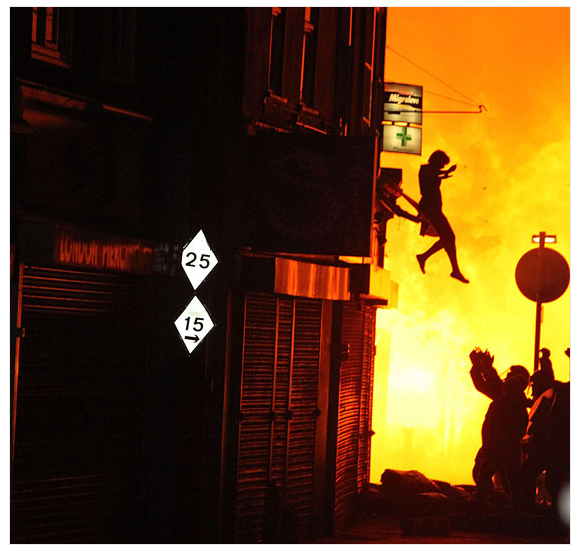
by Amy Weston/Wenn.com via NY Mag
To borrow a line from The Clash, “London’s burning”. And the photographs of the mayhem are stunning. The above shot here is by Amy Weston/WENN.com, as seen in NY Mag. (That image and a bunch more images from NY Mag here).
I’ve been been near riots of this magnitude on two occasions – Paris in 2005-6 and Seattle WTO riots – neither of which I photographed. I’ve also seen a guy get hit by a car and had my camera at the ready but did not shoot. And plenty of other things that I’ve not wanted to photograph. As a pure photographer, only-career-I’ve-ever-had guy, I’m not sure what’s in me that doesn’t pull me to want to shoot so many of these photos, even when I’ve had the chance (like this post). I’m deeply moved by such images -ala London riots, or trama, or the war in Afghanistan. Often times these images are so important to our culture, but at other times it’s shallow and cold to shoot them. I’m especially conflicted with the images coming out of London.
How about you… When do we shoot? When do we help or decide not to spread the horror?
UPDATE: Interview with the photographer (Amy Weston) that captured the stunning photograph in the earlier post below in an article over here at my Google+ page …offers some insights into what she was thinking and plays well with the ongoing discussion here on the blog and over at my Google+ page. (Add me to a circle if you’re G+ing so I can meet you too).








I think it is perfectly normal to stay true to your style of photography!
On the other hand someone has the obligation to record events like that and that would fall to the News Photographers, that is what they do and do best!
When I was in college we were lucky enough to have James Nachtwey come speak. It was right after his book Inferno came out and he recently returned form another documentary trip.
One of me fellow students asked, (paraphrasing as this was 12 years ago) “how do you do this? How do you stand by and take photos of people starving to death and not put your camera down?” His response is what prompted me to write in.
JN- (paraphrasing) “It crushes you… every time. And as soon as I’ve taken the shot, when I feel its done, I put it down and do what I can. In Africa, we would load our truck 6 times a day with individuals too weak to walk and bring them to the medical tents. But most situations that I photograph are so much greater than one person, so where I personally can affect change is by telling their story, bringing it the masses. And that is only thing that lets me sleep at night.”
Personally, I think it has to be a judgement call on a case by case basis. To take those photos you have to be compassionate on a certain level, and as others have said, if you can make a difference in that particular moment, then put the camera down and help… unless you’er James Nachtwey (or similar).
Thanks for posting an interesting question.
It’s hard to find fault with professional photojournalist who shoot news full time. It’s their livelihood. They shoot mind numbing city council meetings, as well as riots and war. I do take issue with the hordes of people showing up to events like WTO, London riots, etc. with cameras in hand just for the thrill of shooting drama. More and more these wannabe PJ’s are outnumbering the event participants. I’m sure the police have difficulty distinguishing between rioter and photographer. Yes, they have the right to be there, but should they? What value is added by their presence?
The London riots are a tricky. So much of the reason behind it seems to be anarchy for the sake of thrill and mayhem. Images like the one you posted of the lady jumping are moving, but do they add meaning to a mostly senseless act of violence? Is it glorification or documentation?
Personally I think there’s nothing shallow/cold about it, because if no one documents the events (via photo, or video) then how will anyone know whats happening and see the truth of what’s occurring…a recent example of this it Tyler Hicks images of the Somalian famine, all the media was covering political stories, while the NYT placed his Somalian image on the front page, which made people realize that Somalia was going through one of the worst famines it’s had in a long time, and very little was being done to help them.
Also if you take a photo and look at it after and decide it’s too invasive or too personal of a moment or too cold/shallow then there’s nothing forcing you to publish that photo/video of the event, and you can just let it sit on your hard drives or even delete it.
I think it’s important to capture the images. I doubt that these images are stoking the violence. They may help by putting pressure on those in power to take appropriate action to bring it to an end.