


Knowing how to deliver images that play nicely with the current design trends is paramount for any working photographer. But why does one orientation work better than another? My friend Sohail breaks it down in the article below: Horizontal versus vertical and why wide design is pervasive and catching on. Take it away Sohail. – Chase
Thanks Chase. Changing habits is tough. I used to, for the most part, use my iPad in portrait orientation. Now I’m trying to break that habit.
Ditto for things on the shooting side. At one point, I used to leave a vertical grip on my DSLR and shoot in portrait mode. Most of what I shot was vertical, and I loved it.
Now? Not so much.

The obligatory iPad Hero shot
I’m shooting more horizontals. I’m consuming more content in that orientation too. And, like any self-respecting geek obsessed with the underlying reason behind things, I wanted to know why.
I think I’ve figured it out.
1. Tension and space
“Fill the frame.”
Every photographer I know says this. Some are starting to move away from that, but getting closer is generally considered to be a good thing.
I haven’t changed my mind about that, but I have noticed that there is a marked difference between getting closer to your subject while in a vertical orientation versus a horizontal orientation.
Take the image of Dwayne Wade from a past issue of GQ. Here, in the iPad version of the magazine, the example makes much more sense.
In the vertical orientation, Wade’s cut off at, well, his crotch. Or, fine, at the hem of his jacket. He fills the frame, and it’s a great shot (totally dig the suit, by the way).
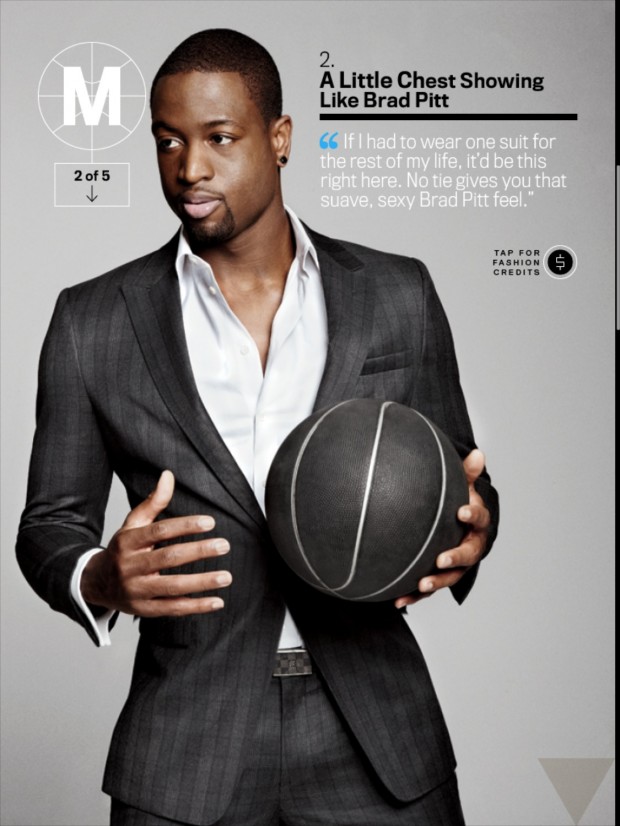
Wade, Vertical
But look at the same image in the horizontal. Here, he’s cut off mid-thigh, and he’s looking off to camera left. There’s space, filled with text and graphics, and there’s breathing room on his sides.
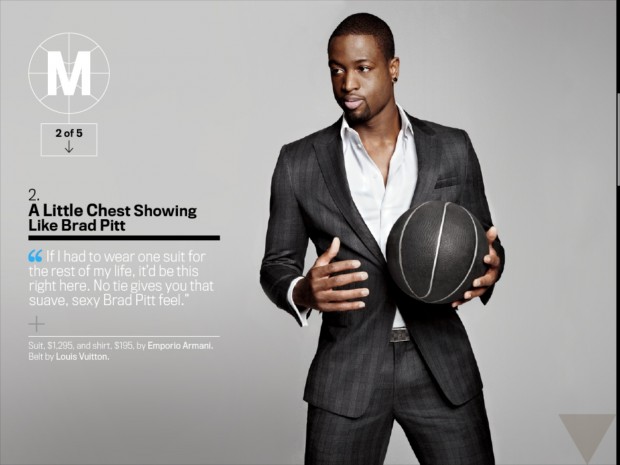
Wade, horizontal
In the first image, he’s being crowded. There’s tension there, but it’s the not-so-good type. He’s looking off the edge of the photo, and there’s almost no room for him to move.
In the second image, his gaze has a direction to go in. You can imagine D-Wade feinting to the left, or pulling back to the right. There’s tension, but it’s the kind of tension that comes from what I think of as potential motion.
That’s the good kind of tension, the kind that exudes an energetic vibe. Horizontally, you get it. Vertically, not so much.
2. Context and room
Take this image from a Dior ad. In the vertical, you see the model, you can see that she’s in a car.
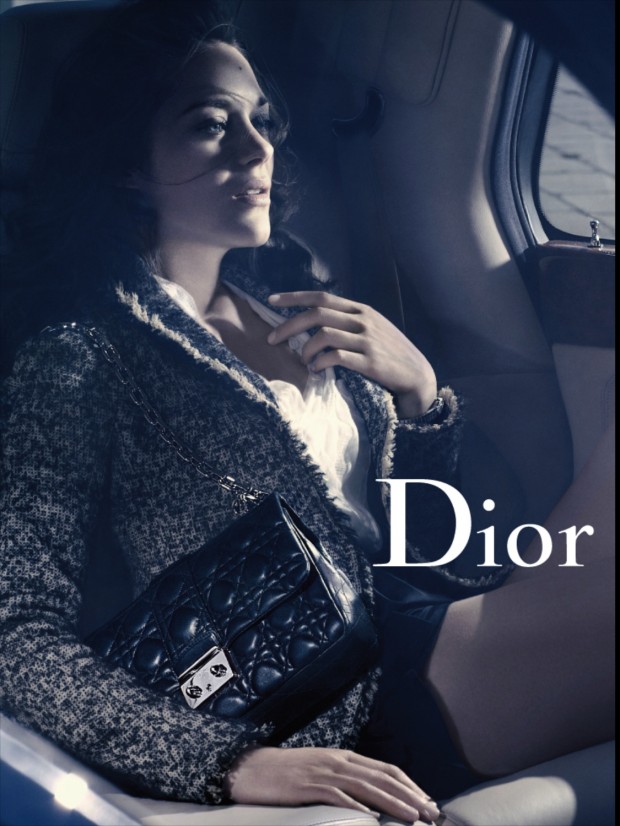
Dior ad, vertical
Switch that out to the horizontal, and… what changed?
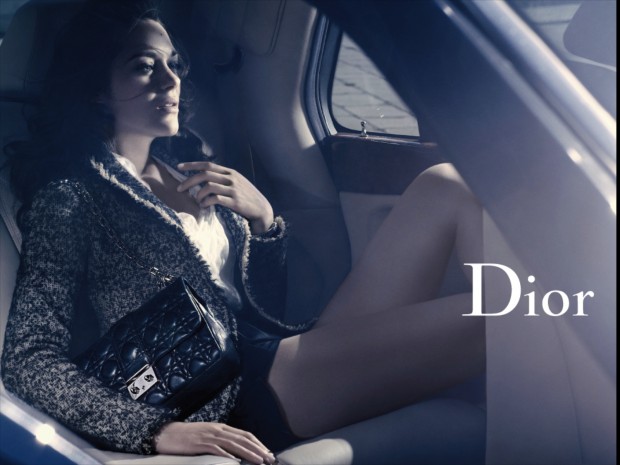
Dior ad, horizontal
She’s still in the same car. She’s still in the same position. Nothing’s changed, except the space you can see in the photo.
I argue this: in the horizontal, she seem more comfortable. Less cramped. She’s got room to move, room to shift.
That room is what makes the horizontal image seem more luxurious than the vertical. I look at that vertical, and I think, “Yeah, she’s in a car. It’s probably a nice car.” The horizontal image, however, changes that to “Oh yeah, she’s definitely in a nice car. Look at how she’s chilling in that seat, look at all that room.”
Context is another reason why I’m digging horizontal images more. This ad from Longchamp Paris is an excellent example. The vertical focuses on the model and the bag, which is fine. she’s at edge of the frame, an elbow cut off. Nice image, but again, all I can see is that she’s on a motorcycle on a country road.
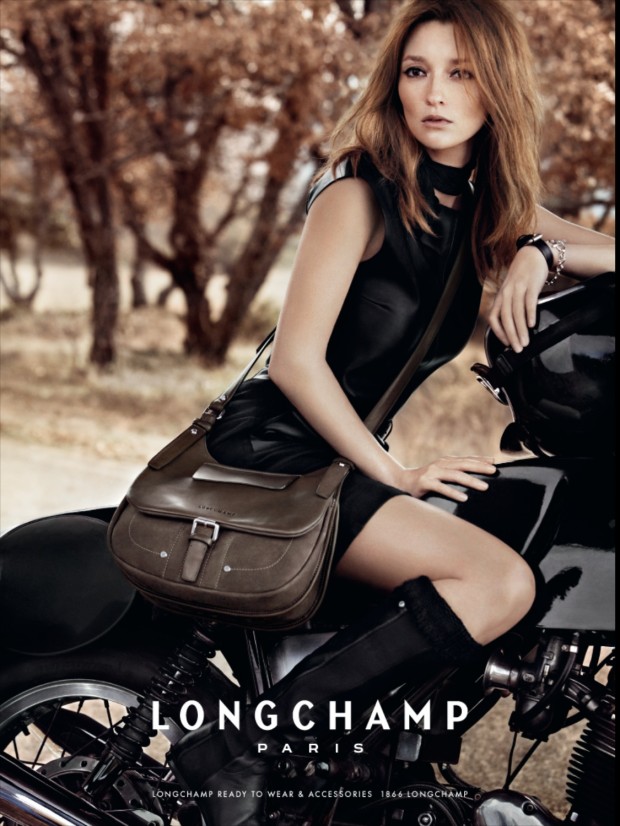
Longchamp ad, vertical
Cue the horizontal. Now it’s a whole new story.
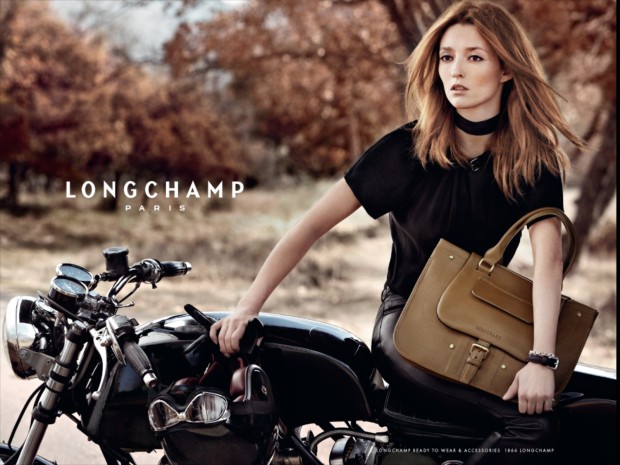
Longchamp ad, horizontal
The motorcyle is vintage. The helmet and goggles in her right hand could be straight out of the forties, fifties, maybe sixties. That adds context to the image, gives it a sense of place and time.
It makes the image come alive with meaning, and you buy into the picture of motoring down a French country road on a vintage Triumph, this gorgeous woman with her Longchamp Paris bag hanging on to you.
That’s context.
3. We see horizontally
Okay, human vision isn’t really horizontal or vertical. But I do think we see things primarily on the horizontal axis. We read either left to right or right to left (the Chinese and Japanese systems being the notable exception). We see things that are in a horizontal panorama that stretches across our vision. How often do you look up and down, versus side to side, when you’re just walking around?
Visually too, we are trained to see things in the horizontal. Your TV is a widescreen, as is your laptop’s screen. Movies are made in widescreen, not narrowscreen. You drive, you scan left and right, because there’s no reason for you to look up.
I argue this: the horizontal is more natural for most people.
iPhone users – do this. Take out your iPhones and make a quick video, with your phone held vertically.
Now make the same video, but switch your phone to the horizontal orientation before hitting the record icon.
Which one’s easier to watch?
The when and why of vertical
Verticality (yes, it’s a word) is around us. It’s pervasive too. Our book pages are vertical. Our magazines are vertical. I thing that human beings prefer to read in narrower columns than wider ones.
The vertical page is more convenient to hold as you read it. I can hold an 8.5 x 11 page quite firmly along one edge, with one hand, as I read it, but if I switch it to horizontal, I have to use both hands.
That’s why magazines have been vertical, I think. It’s a lot easier to read a magazine with one hand if you’re holding it vertically.
But in case it hasn’t escaped your notice, most situations where the vertical is more appropriate have to do with the written word – and even there, as I said, we still manage to insert a bit of horizontality (yes, also a word) by reading left-to-right or right-to-left. For images, I think, by and large, that we prefer the horizontal over vertical.
Final word
My iPad is more comfortable to hold vertically. There’s no denying that. When I hold it horizontally, I feel like I’m cantilevering it with my hand. It’s annoying.
But honestly? It’s a small price to pay, because I enjoy looking at images a lot more. Photographers often realize this; guys like Michael Nichols and Steve McCurry, who are selling apps comprised of their work, don’t even offer you the option of viewing the app in portrait orientation.
Gannon Burgett over at Gizmodo recently did an article titled “13 Design Trends for 2013.” One of the trends (number 7) was “Wider Websites.” He writes:
By offering wider websites, it also allows for visual media to be more prominently displayed alongside the text. A picture can speak way more than a thousand words in some cases and having a beautiful photograph at 700 pixels doesn’t do it justice.
I argue that this design trend also holds true for just pure images.
Sure, there are images where the vertical works better. I once saw a great image of a kayaker about to go over the edge of a waterfall that must have been about a hundred feet high. In that shot, a horizontal might not have conveyed the gravity (no pun intended) of the situation.
Yet I find that these circumstances are few and far between. For me, at least, landscape works better than portrait, and I’m happy to accept that the new horizon(tal) is here, at least until something comes along to beat it.
PS – Have you checked out Affinity Studio, Nano Banana and Meta AI? Great free alternatives to Adobe Creative Cloud and Midjourney.





Ah, but what about mobile? Square seems to dominate there. And those pad things are getting to be a little old fashioned : )
I’m an web/app designer and photographer.
I design my websites to be responsive which is a technique to make sites adapt to any resolution (or other cirumstances such as high pixel density screens)
Basically it’s simple – a wide shot + 36MP D800 shots give you lots of wiggle room to compose the shot in a proper way for each context, be it wide, portrait, phone, TV, magazine or whatever medium.
For websites I often need extreme panoramas (10:1 ratio or more), for iPad apps I need both vertical and horizontal shots. Wide horizontal shots give me the most (layout) options.
With regard to the article, I respect your choice, but I think your argument is flawed.
Western society doesn’t read horizontally, it reads horizontally )in short bursts). It’s very difficult on the human eye to look too far left and right without turning the head, it strains the eyes (like when you sit too close to a large wide screen TV). There’s a reason the head moves naturally and effortlessly left and right, because the head is so well balanced. The head is harder to move up and down, using many neck muscles to make this action so it doesn’t damage the neck. In turn, the human eye has evolved to naturally look center and center/down without much effort. It’s why they say to place the top of a monitor at forehead level, so the eye can easily look down. Looking left, right or up for too long strains the eye muscles and dries the eyes out quickly.
From a brain standpoint, humans have difficulty reading horizontally for more than a few inches. Beyond that, the brain starts to get lost and lose the meaning of the words. But with shorter horizontal lines and more vertical lines, the mind is able to keep things organized. Try picking up a book and making a small mark where you stopped reading on the page, make sure it’s mid-sentence near the middle to right side of the page. Pick it up the next day and the majority of people will search for the rough vertical area on the page they think they stopped, then look for the horizontal area/mark they stopped, it’s how our brains compartmentalize. With regard to iPads and tablet, I think you’ll be hard pressed to find a reading app out there that spans the width of the page when held in the horizontal position (unless the words are very big). Most apps, like Apple’s Book app, break it into two pages, one of the left, one on the right, to make reading easier to navigate.
With regards to magazines and pictures, we shoot vertically because we have to. It’s easy to say, “I like driving Bentley’s more than I like driving Nissan’s.” Sure, but just because something is nicer doesn’t mean I have the luxury of doing it. Full spread ads with horizontal pictures are expensive, if they weren’t, every ad would be horizontal to take up more space to show the item they’re trying to sell.
“For images, I think, by and large, that we prefer the horizontal over vertical.” It’s great if YOU prefer horizontal, but speaking for EVERYONE lands people in trouble. Is it easier to view horizontal? Sure, in some instances. Our eyes can see 180 degrees left and right, but only a fraction of that up and down before our eyebrows and nose/cheeks stop us from seeing more. So it’s physically easier to look at wide vistas than tall skyscrapers. But creating an image is about creating a piece of art, and to say that it’s better to create a piece of art in a horizontal setup versus vertical is like saying chocolate is better than vanilla is better than strawberry is better than rocky road.
Sorry if I got too douchy. Speaking from self and personal preference is difficult to argue. When someone speaks for me, it comes across as if they’re trying to take away my personal experience and relationship with art.
Of the two photographs featuring women’s bags I actually prefer the vertical shots. With the vertical Dior advert the bag has as much emphasis as the model, more so owing to the retouching – the bag is where the emphasis is… with the horizontal version there’s so much visual space that my eye wanders all over the image, my gaze doesn’t fall on the bag nearly so much. With the Longchamp advert, again the bag seems to assume more importance with the vertical version, the female model is sat in a natural position on the bike and her sinuous ‘S’ pose leads my eye naturally down to the bag, even the suspension spring ‘points’ upwards to the bag placed on the diagonal of the image whereas the horizontal version has the model sat a little awkwardly though at least the bag is in the lower right quadrant which is fine but the motorbike has as much visual space as the bag and might be something of a distraction. I’d be interested in seeing some analysis done of eye movement to see where the viewer focusses more often to see whether horizontal wins out over vertical for the two bag adverts… in terms of how much time is spent looking at the bag itself before deciding what the context is within the frame.
I agree with Howie and I would take it further, that all three of these examples have more impact and are more dramatic in portrait rather than landscape. As a photographer I want the viewers eyes to be drawn to what I deem the focal point of the image, just as an advertiser would want the viewer to end up focused on their product. In the Longchamp’s example the portrait shot is perfect for this. In the landscape example the viewers eyes just keep wandering and wondering what they should be focused on, the girl, the bike, the purse or the trees.
Sorry I do not buy into your argument in general and certainly not with the above examples.
Great article. All movies are in landscape format. This will become more prevalent with the advent of recording video on DSLR’s and their like.