

I love how opinionated this community is. There is no right, no wrong – just a good bit of discussion…
In case you’re lost, I promised to follow up this earlier popular Which Photo is Better A or B? post. The discussion on these is always spirited–in this case the post received more than 1000 comments in 24 hours–of which I read them all. A breakdown by numbers, my particular take (it was different than most of your votes), and a fascinating old JWT video that features Stephen King and a box of hammers, which subtly reveals a good bit about products and our emotions around them, all after the jump…
First, here’s a breakdown.
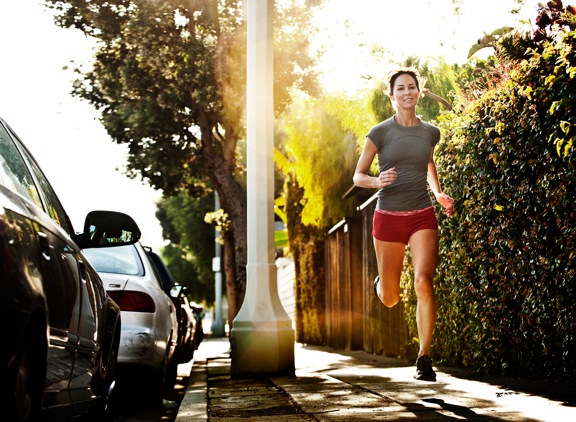
1. By popular voting, reader choice is Photo A. Overall opinions mostly hinged on the facts that “you could see more of the product” OR it was non-vote for B, in which the sentiment was centered on “the lens flare is too distracting”…
2. This advertising image was indeed shot for LuluLemon and, true to our readership popular voting, the final call on this image from the client was indeed Photo A. I like A. It’s a super solid shot. Clear. Tight. Right on brief and right on my personal style.
3. But my preference was for image B. I like the special sauce that the flare adds. That said, I certainly and completely understand the client choice – professionals always default to the people writing the checks. There are often clear marketing objective that play a role before the shoot AND many objective arise/come out during and after the shoot… In the end, to the credit of LuluLemon’s team –and they’re a really smart bunch– they really wanted to see the product since it was one of their first foray’s into running wear. I love the final image in A, but it’s perfectly ok for me to like B a little more.
Here’s why:
(First another glance at the images.)
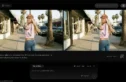
This is PHOTO A, below.
THIS is PHOTO B, below.
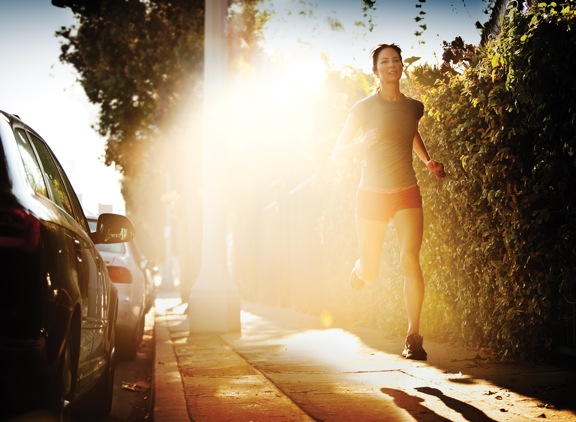
First – remember I’ve talked at length before (post here: photographers push your art directors….) about my creative approach when on commercial shoots…. My initial goal: making the image from the creative brief…focused on pleasing the client, checking all the awesomeness boxes, where everybody on set looks at one another and says “we got the shot”. THEN, after that moment, push things a little bit and say “let me experiment”…push the concept a little more, check your own awesomeness box and throw that image into the mix for final selection. That was at work here. Image A was “the brief”. Image B, was me adding points of flare. In this case, a flare 😉 [*Note also that I often report on the client then choosing my “special sauce” image? Well, doesn’t always happen – as in this case here…But not to worry.]
Ok. I like image B purely because of the emotion involved. The emotion that the image makes me feel, the emotion that’s on the runners face, the emotion that I, as a runner, connect with when I go for long runs at sunset and my eye does the same thing that a camera sensor does when the sun hits it, etc. I disagree with technical arguments against this image. I worked for about 40 minutes to get this shot. The lens rendered the image beautifully, as did the camera. If you make the distraction image, I’m not buying it either. But that’s just me. I’m looking for the substance of the photo and it’s obviously not all to be found in the flare. My eyes move thru the photo.
There are always, as I mentioned above, marketing objectives that drive the content of commercial images… That’s their nature. But where the tug of war happens — and why I selected this pairing of images — is that the marketing objectives (here to make a really nice, connecting shot with the runner and the product) are sometimes at odds with a purely emotionally response based image. In fact, I believe that if you take away most of the technically-based comments below, that a majority of the people would actually connect more emotionally with Image B. Like yours truly.
Isn’t that the highest goal of an advertising image? To connect emotionally with the product or service? Debatable indeed, but it’s how I like to think about it. From both a creator perspective and as a buyer of stuff. It’s partially The client can always — and often does — think more comprehensively about the campaign than the artist who is actually shooting the campaign but my sentiment is emotion. Let the people higher on the pay scale decide the rest of the stuff…
With regard to commercial art specifically, I personally share a view shared in part by uber-planner (creative strategist) Stephen King puts it, as pulled from buddy of mine Feris Yakob over at Talent Imitates, Genius Steals:
“- communication is an indirect force rather than a direct persuasive one
– its primary role is to intensify a brand’s meaning totality (‘brand gestalt’) by creating intensity of feeling, rather than conveying rational messages
– it works most effectively by building long-term brand associations & values rather than via short-term sales shifts
– a planner’s role (photographer’s perhaps) is to … not get dragged into the nightmarish mechanistic false world of purchase intent methodologies.”
Pretty much sums up why we need to be pushing creativity to clients that we believe in, right? Ultimately they make choices based on bigger spheres, budgets, jobs, goals, etc than we do creating the work, BUT it shouldn’t keep us from making the stuff we feel is most creative after you “get the shot”.
What say you?
[Final departure: here’s a funny old 1970’s JWT agency video where these gents articulate in/around the emotional side of hammers and dress suits. Worth the 90 seconds if you like this stuff. ]





I get the upsetting answer of blank eyes and people telling me that i have some kind of dramatic and irrational point of view when i talk about theses kind of things, at east here… I would really like to make the jump and start pushing things to another spaces that are yet to be discovered, when brands and products have still untold stories with clients, users and mor over: PEOPLE. People that feels, cares, hurts and love.
All of the above, should be considered in one single and appealing image.
Cheers Chase.
First of all, thanks for wading through more than 1000 comments! That’s a feat unto itself. I immediately reacted to B (the flare made me anxious), but had a feeling the client would choose A. It seems more commercial and maybe more accessible to a greater number of people.
Personally, I could stand to learn more about getting the shot ‘they’ are looking for. Normally, once I’ve learned the mechanics, I’m on my own program for shooting. The difference being that I am not trying to support myself and don’t need to get that perfect shot that sells.
Wow, amazing to think you read over 1000 comments. Thank you so much for posting the follow up. I really enjoy being able to express my opinion, and read other people’s reasons. I truly love being able to hear after all the discussion both what your personal opinion and the choice of the client. This was by far my favourite A vs. B post and follow up you have done.
It’s easy to agree with someone after the fact the decision has been made so I hope I’m not perceived as a yes man, but I’ll still voice that I like B better as well. For one, the runner doesn’t appear to be looking at the camera so it feels less posed. And yes, there is a lot more emotion there. She’s just running, and she’s enjoying it. She’s experiencing that feeling of just being in the moment where your brain turns off, the world goes away, and you just run. The way the flare hits you in the eye almost makes you feel like your a runner passing by. I also like the vignetting in the sky, which is not in image A.
product advertising: A
creativity: B