


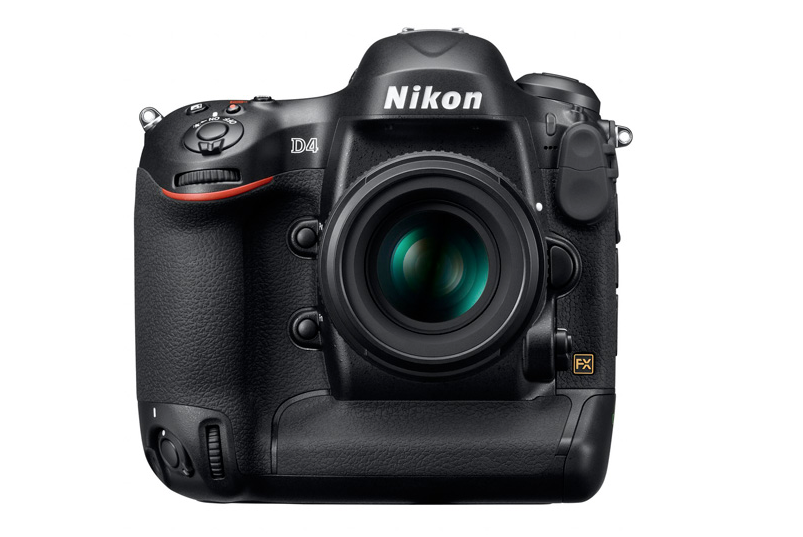
photo via Gizmodo
Here’s some highlighted specs:
_16.2 effective megapixel, full-frame sensor (16.6MP total)
_10fps shooting with AF and AE, 11fps with focus and exposure locked, 24fps 2.5MP grabs
_1080p30 HD video at up to 24Mbps with uncompressed video output
_91,000 pixel sensor for metering, white balance, flash exposure, face detection and active d-lighting
_ISO Range 100-12,800 (extendable from 50 – 204,800)
_MultiCAM 3500FX Autofocus sensor works in lower light and with smaller apertures
_Two sub-selector joystick/buttons for shooting orientation
_New EN-EL18 battery (21.6Wh capacity, CIPA-rated at 2600 shots)
_Twin card slots – one Compact Flash and one XQD
Please note I HAVE NOT touched one of these cameras, and NO I didn’t shoot the campaign. and I haven’t yet spent the appropriate time with the camera to tell you any gory details. I’m assuming I’ll be able to chat more soon.
So.. I (we) knew this was coming, but rather than me spouting off about having played with the system (I can’t), or telling you what your feelings about this system should be (I won’t), I’m turning the tables on you.
What’s your take? Love, hate, indifferent? Insights?
[Reminder that Nikon plays close attention to this blog, so your comments on this post – glowing or otherwise – might help inform Nikon about what your thinking.]Link to all the Nikon D4 details and/or purchase here via B&H.













Chase, I’m curious why Nikon chose to not use resources on an extended resolution sensor like the Canonites are so accustomed to. One hand would suggest that the resources were simply used elsewhere, or that the market didn’t demand such resolutions. The other hand might suggest that they were conserving pixel pitch and I can’t wait to read more about the capture and processing power of the chip. When low light photos start hitting the tubes, I’m sure we’ll all have plenty to talk about. True that few of us are shooting billboards, but some of us wedding and social photographers depend on cropping in post more than the rest of us, so would’ve like to see a little more beef from the sensor.
I’m really glad that Nikon is aware of its motion market, and the emphasis on video output options and high speed shooting (wow, >10fps?) lets creative professionals grow with the industry and focus a lot more on video work. I think this is a killer benefit, and I hope it encourages semi-pros and pros to take the Chase path and start experimenting with mixed media. Hell yes for uncompressed video.
Only bummer I see is the Compact Flash’s return. True it’s a pro standard, and I’m curious where XQD will take our community’s data management, but I’m a tremendous fan of the portability of the SD card – it has been my ideal solution for quick transfers to laptops in the event of emergencies, quick presentations to clients on the iPad (with Apple’s SD reader), and especially in affordability and availability. On the road, if you need an SD card, a short stop at a consumer electronics store is all that’s required. Probably not the same case with CF, and especially XQD for a little while. Though I’m excited about new data rates that necessitate the card media market’s growth.
Sorry, long winded. I’m excited that Nikon overcame the Japanese disaster and is back to grindstone putting pressure on Canon. It’s a great time to be a photographer! Chase, thanks for all the education and inspiration.
I’d love to be part of this discussion. Please contact me at your earliest convenience for my address, so you can send me a test body to play with, and I’ll be happy to share ALL my insights! 😉
I’m not a FX shooter, but would it not have been better to have the MP closer to 20, 16 seems a bit low, especially compared to the 5D MKII with 21 MP.
That being said, I wish I could afford it and finally go full frame.
I’m going to throw the question back at you. Why? While I read up on camera technology, I have not, nor do I know how to compare the highest tier cameras because I have not used them. Sure, you can compare technical specs and crunch numbers, but I think it boils down to preference and the job at hand. I haven’t used any of the Canon 1D or the Nikon equivalent cameras, but I do have a 5D Mark II.
Do you find yourself limited by your D3X/D700s? Can you justify the cost of an upgrade? Why would anyone want to upgrade to this camera from the D3X (assuming they aren’t sponsored). Is it the native video support (1080p) that will push people into buying this?
Chase, what was the most notable upgrade for you in your history as a photographer? I can see film to digital (and that may not be seen as an ‘upgrade’, just a change) being one of them, but how about digital specifically? Has upgrading from one model to another made your job orders of magnitudes easier? Does it not have to be orders of magnitudes? Is a *little* bit easier enough for you to upgrade?
I can see the top tiered media outlets upgrading for the competitive edge (NYT, Nat Geo, etc). That seems to be the target market for this tier of cameras. What do you think?
The new XQD cards are lightning fast and should have completely replaced the compact flash card slot for a dual XQD slot system like the dual SDXC card slot system of the D7000. If they held off on abandoning the CF card slot, they should have offered a battery that shared the same shape and contacts. So instead of introducing a revolutionary, standards-setting camera, Nikon introduced more of an “interim” camera, or something that slowly brings users over to the new standards. Professionals are usually on the cutting edge and don’t need to be bled over to the new technology like the average consumer would. A transition to new media storage with faster read/write speeds would have been welcomed with open arms. Now D4 users are forced to carry 2 forms of memory cards and 2 types of card readers. A inconvenience brought on by poor product development.