

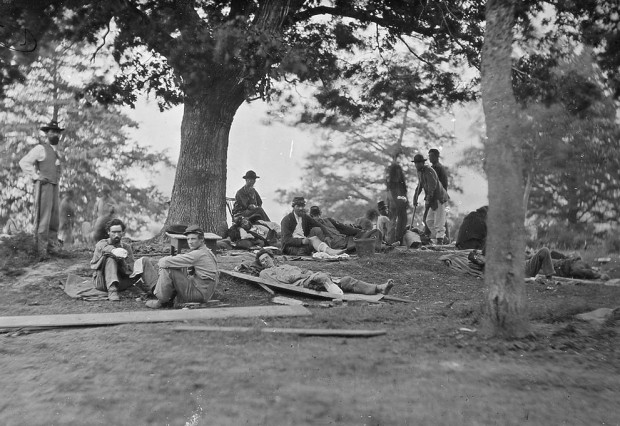
Mathew Brady/NARA, via The Atlantic
The Vietnam War is often credited as the first conflict that was actually brought into the homes of American civilians. Graphic television reports, blooding images on black-and-white televisions…a lot has changed about the way we cover the war.
But this series in The Atlantic captured my attention and pointed it to the first American war where photographic images were even captured. Made me realize how, even though photography has changed, and war has changed, the images of war haven’t really changed at all.
Click through the photo tabs above and compare these photos–from the Library of Congress and the National Archives and Record Administration–of the Civil War to the photos you see everywhere in modern conflicts, in the Middle East, for example. The clothing is different, the technical details might have changed, but besides those peripherals, the photographs of war are fundamentally the same.
Erie as all hell. Is this a commentary on our human approach to photographing conflict? or is this a commentary on war? Neither or both?
______
**Update/Aside: Come watch us work. Mark your calendars to join us LIVE online on Wednesday, February 29th. We’re broadcasting a LIVE, interactive fashion shoot with the legendary $150,000 Phantom cinema capturing 1000 frames or more per second in HD resolution. Details are here, attendance is free. Tune in.










It´s the never ending story. At least that´s how it feels.
Wow. In general it amazes me that humans by default do not have the capacity or mentality to get along with each other.
From your own siblings, neighbor, street blocks, town,county, state, country, continent and soon planets. What is wrong with us?
I feel like this time-lapsed gallery of conflict represents our human outlook for the conflicts at hand. No matter where we go throughout the world or when it takes place a casualty is a casualty and destruction is still destruction. Sort of builds on our minds as entities that need capturing. Maybe its the continuous fear and rush of the moments or the lack of control in situations but it seems the only major change is the scale that they have to represent. Im not sure what is required in order to make an impact as powerful as photographs during earlier years. Its a shame that with all the noise that comes with media today, most war and conflicts around the world are seemingly ignored. Maybe it is a little of both human and war commentary. War, as advanced as it has become, is still a simple concept at its roots with death and destruction captured. Consequently, our human curiosity could easily be after creating impact.
Cody
The photos indeed are the same, what changed was the way the information is accessible to a broader audience
I had a few discussions on this very topic this weekend…looking over a personal collection of a work colleague taken by a USMC private during the Pacific Theater in WWII…they were hard images to see and really haunting.